
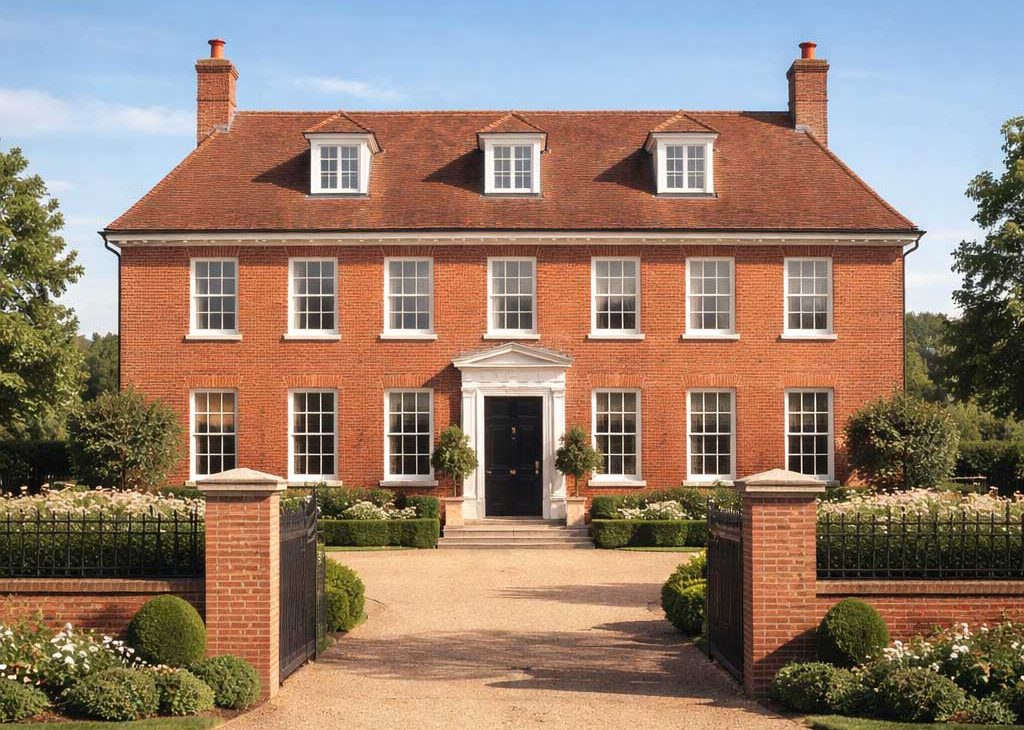
Georgian architecture remains one of the most enduring and recognisable styles within the English countryside. Defined by its symmetry, proportion and classical detailing, the Georgian country house continues to influence both the restoration of historic estates and the design of new-build homes inspired by traditional architecture.
Across counties such as Hampshire, Berkshire and Surrey, there has been a renewed interest in creating homes that reflect the elegance of Georgian design while accommodating the expectations of modern living. These properties are often substantial in scale, requiring a carefully considered approach that integrates architecture, interior design and landscape into a cohesive whole.
Designing a Georgian country house is therefore not simply an exercise in aesthetics. It is a process of understanding proportion, materiality and spatial composition, ensuring that every element of the home contributes to a sense of balance and refinement.
The Principles of Georgian Architecture
At the heart of Georgian design lies a commitment to symmetry and proportion. Facades are typically arranged around a central axis, with evenly spaced windows and carefully balanced elevations.
Internally, this architectural clarity is reflected in the arrangement of rooms. Formal spaces are often positioned along the principal elevation, with a sense of hierarchy that guides movement through the home. Ceiling heights, door placements and window proportions all contribute to a consistent architectural rhythm.
For new-build Georgian homes, these principles must be interpreted with precision. The success of the property depends not only on its external appearance but on how these classical proportions are carried through into the interior.
Interpreting Georgian Design in Contemporary Homes
While Georgian architecture provides a clear framework, modern living introduces new requirements. Open-plan kitchens, informal living areas and integrated technology must be accommodated without disrupting the architectural integrity of the home.
This balance is achieved through careful spatial planning. Rather than removing structure indiscriminately, designers reinterpret traditional layouts to create more fluid connections between spaces while maintaining a sense of order.
Our guide to planning a luxury home renovation explores how early design decisions shape the structure and flow of a home, whether working with a historic property or a new-build inspired by classical architecture.
Interior Design for Georgian Country Houses
Interior design plays a central role in reinforcing the architectural language of a Georgian home. Materials, colour palettes and furnishings must all respond to the proportions and detailing of the building.
Natural materials such as timber, stone and plaster contribute to a sense of permanence, while carefully considered colour schemes enhance the elegance of the space. Furniture is often arranged to reflect the symmetry of the architecture, creating interiors that feel balanced and composed.
For historic properties, our article on interior design for period homes explores how contemporary interiors can be introduced while respecting architectural heritage.
Kitchens and Informal Living Spaces
In Georgian homes, kitchens were traditionally located away from formal entertaining areas. In contemporary properties, however, the kitchen has become a central social space.
Designing these areas requires a sensitive approach. Open-plan kitchens and family spaces can be introduced in a way that complements the architecture rather than competing with it. This often involves extending or reconfiguring certain parts of the home to create more generous, light-filled environments.
Our guide to kitchen extensions for period homes explores how these transformations can be achieved while maintaining architectural harmony.
Bespoke Joinery and Architectural Detailing
Bespoke joinery is essential in Georgian interiors, where precision and proportion define the overall aesthetic. Wall panelling, fitted cabinetry and architectural mouldings all contribute to the character of the space.
Rather than appearing as separate elements, joinery is designed as part of the architecture itself. This approach ensures that storage and functionality are integrated seamlessly into the interior.
Our article on bespoke joinery in luxury interior design explores how custom craftsmanship enhances both the functionality and visual balance of high-end homes.
New-Build Georgian Homes and Design Coordination
Many contemporary Georgian country houses are newly constructed, designed to reflect classical architecture while incorporating modern construction methods and technologies.
In these projects, coordination between architects, interior designers and consultants is critical. Early design involvement allows interior layouts, architectural detailing and material selections to be developed together, resulting in a more cohesive and refined outcome.
For homeowners embarking on new-build projects, our guide to when to hire an interior designer for a new build explores how early collaboration can shape the success of the entire project.
A Cohesive Approach to Country House Design
Designing a Georgian country house requires more than an appreciation of architectural style. It demands a holistic approach that considers how architecture, interiors and landscape work together to create a unified living environment.
At Kings Interiors Ltd, our work across Berkshire, Hampshire and the surrounding counties focuses on creating refined residential interiors that respect architectural tradition while supporting contemporary lifestyles. Whether working on the renovation of a historic property or the design of a new country house, our approach is grounded in careful planning, craftsmanship and attention to detail.
Homeowners considering a country house project may wish to explore our luxury renovation interior design services or contact our team to discuss your project.